

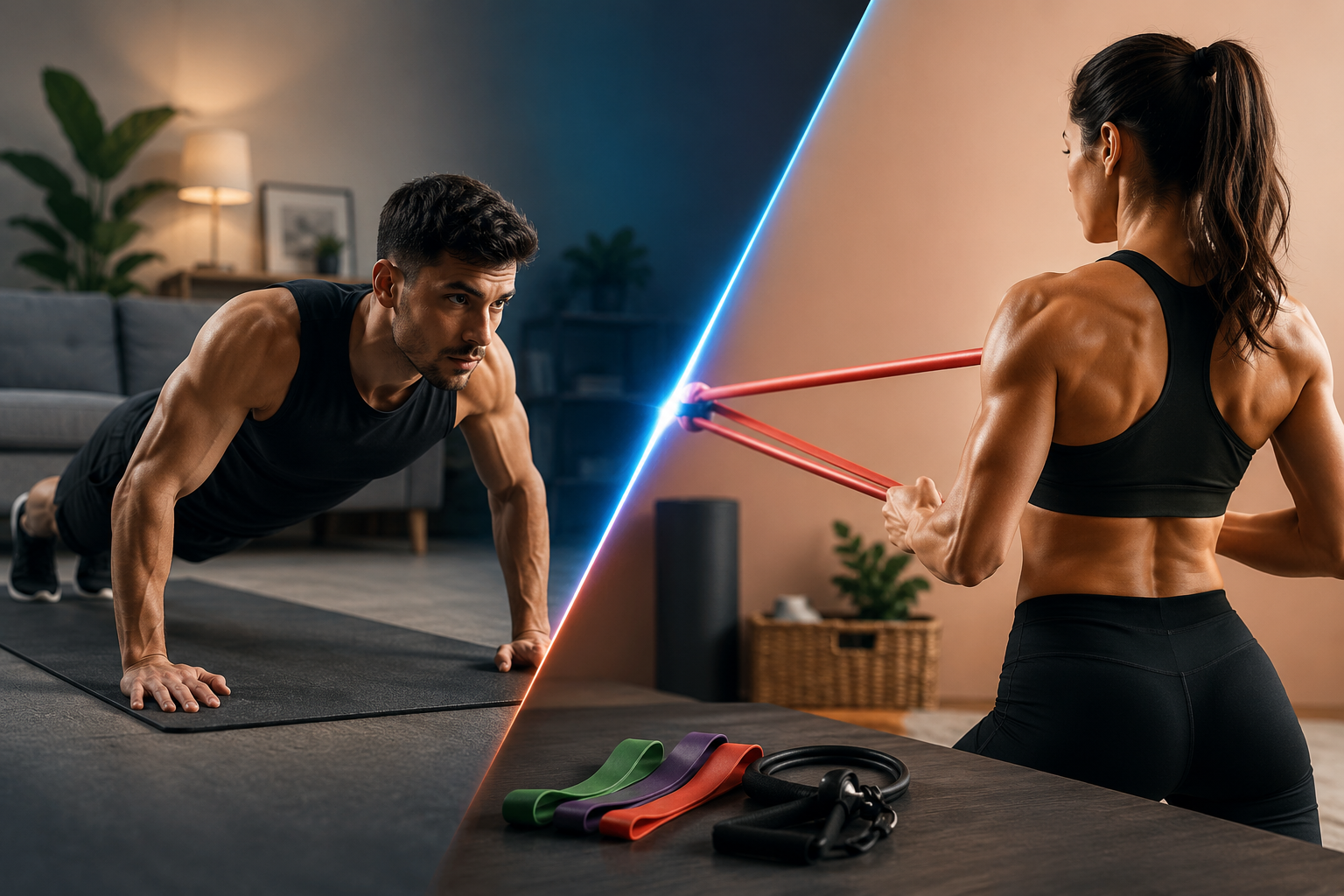
Building a consistent fitness routine at home does not require an expensive gym membership or a room filled with equipment. Two of the most accessible options are bodyweight exercises and resistance band workouts, both of which can help improve strength, mobility, balance, and overall fitness. However, they work the body in somewhat different ways, which can make one option more suitable than the other depending on your goals, fitness level, and available space. Understanding the differences between bodyweight exercises vs. resistance bands can help you create a home workout routine that is practical, progressive, and enjoyable.
What Are Bodyweight Exercises?
Bodyweight exercises use your own body as resistance. Movements such as squats, lunges, push-ups, glute bridges, planks, and mountain climbers can train several major muscle groups without requiring additional equipment. Because your body provides the resistance, these exercises are particularly convenient for beginners, travelers, students, and anyone who wants to exercise without purchasing fitness equipment.
One of the biggest advantages of bodyweight training is its versatility. A beginner can start with modified movements, such as wall push-ups or assisted squats, and gradually progress toward more challenging variations. Someone with greater experience can increase difficulty through slower repetitions, longer pauses, greater ranges of motion, or advanced movements. Bodyweight workouts can also improve coordination and body awareness because many exercises require you to control your own movement rather than simply moving an external weight.
What Are Resistance Band Exercises?
Resistance bands are flexible bands made from materials such as latex or synthetic rubber that provide tension as they are stretched. Unlike traditional weights, resistance bands are lightweight, portable, and easy to store, making them especially useful for home fitness. They can be used for exercises such as rows, chest presses, lateral walks, shoulder movements, biceps curls, triceps extensions, and squats.
A major benefit of resistance bands is that they make it easier to add adjustable resistance to your workouts. Different bands can provide different levels of tension, while changing the length of the band or your position can also alter the challenge. Resistance bands are particularly useful for exercises involving pulling movements, which can be difficult to replicate with bodyweight alone. This makes them a valuable tool for developing a more balanced home workout program.
Bodyweight Exercises vs. Resistance Bands for Strength
When comparing bodyweight exercises vs. resistance bands for strength, neither method is automatically better for everyone. Bodyweight training can be highly effective for developing functional strength, especially when exercises involve multiple muscle groups simultaneously. Push-ups, for example, require the chest, shoulders, triceps, core, and other stabilizing muscles to work together. Squats and lunges similarly challenge the lower body while requiring control and balance.
Resistance bands, however, can make progressive resistance easier to manage. As your strength improves, you can move to a stronger band or increase the tension during an exercise. Bands also provide resistance throughout much of a movement and can be especially useful for targeting smaller muscle groups. For someone whose primary goal is building strength while training at home, combining bodyweight movements with resistance bands may therefore provide greater variety and progression than relying exclusively on either method.
Which Is Better for Muscle Building?
For muscle growth, the most important consideration is not simply whether an exercise uses your bodyweight or a resistance band. Muscles generally need sufficient training stimulus and progressive overload over time. If an exercise becomes too easy and you never increase the challenge, progress can eventually slow down.
Bodyweight exercises can support muscle development when appropriately progressed. A standard squat can eventually become a split squat, Bulgarian split squat, or another more demanding variation. Similarly, regular push-ups can progress toward decline push-ups or other challenging variations. Resistance bands offer another straightforward way to increase difficulty because stronger bands can provide greater resistance.
For people training primarily at home, resistance bands can therefore be particularly helpful when bodyweight exercises have become too easy. However, they do not replace every form of resistance training, and people seeking substantial muscle or strength gains may eventually benefit from heavier external resistance and a more structured training program.
Which Option Is Better for Beginners?
For beginners, bodyweight workouts are often an excellent starting point because they require little preparation and help people learn basic movement patterns. Learning how to squat, hinge, push, brace the core, and maintain good posture creates a useful foundation for future exercise.
Resistance bands can also be beginner-friendly, but proper technique is important because the band creates tension that changes as it stretches. A beginner should start with manageable resistance rather than choosing a band that makes it difficult to control the movement. Gradually increasing difficulty while maintaining good form is generally more valuable than trying to make every workout extremely challenging.

Benefits for Flexibility, Balance, and Everyday Movement
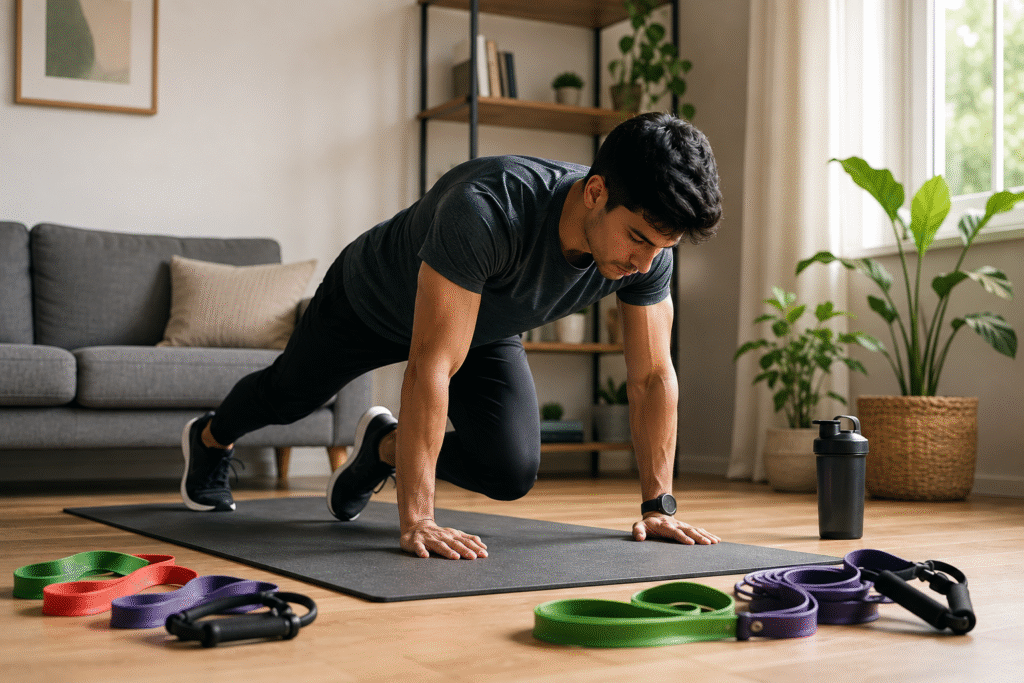
Home fitness should not focus only on strength. Mobility, balance, stability, and coordination are also important for maintaining physical independence and performing everyday activities comfortably. Bodyweight exercises naturally encourage control over your own body and can challenge balance through movements such as lunges, single-leg exercises, and controlled squats.
Resistance bands can complement this by strengthening muscles involved in joint stability and movement control. Band exercises targeting the shoulders, hips, and upper back can be useful additions to a balanced routine. The key is to perform exercises with controlled movements rather than relying on momentum or rushing through repetitions.
Can You Combine Bodyweight Exercises and Resistance Bands?
For many people, combining both methods is the most practical approach. A home workout might use bodyweight movements for foundational exercises and resistance bands to provide additional resistance or target muscles that are harder to train effectively with bodyweight alone. This combination can keep workouts interesting while providing more opportunities for progression.
For example, bodyweight squats can train the legs and hips, while banded rows can provide an effective pulling movement for the upper back. Push-ups can challenge the chest and triceps, while band exercises can target the shoulders and arms from different angles. This combination creates a more varied full-body home workout without requiring bulky equipment.
How to Choose the Right Home Fitness Method
Your choice should ultimately depend on your fitness goals, experience, available space, and personal preferences. If convenience is your highest priority, bodyweight exercises are hard to beat because you can perform them almost anywhere. If you want greater resistance variety or need more options for upper-body pulling exercises, resistance bands can be an excellent investment.
Consistency is also more important than choosing the theoretically perfect training method. The best home workout is one you can perform safely and consistently over time. Starting with manageable exercises, learning proper technique, allowing adequate recovery, and gradually increasing the challenge can produce better results than frequently changing routines without a clear progression strategy.
Supporting Your Fitness Routine With Healthy Lifestyle Habits
Exercise is only one part of a healthy lifestyle. Adequate sleep, hydration, nutritious food, and sufficient recovery all influence how effectively your body responds to physical activity. Maintaining a balanced diet that provides enough protein, carbohydrates, healthy fats, vitamins, and minerals can support energy levels and recovery.
Alongside regular exercise, many people also enjoy beverages that fit naturally into a wellness routine. Livisca Green Tea can be included as a refreshing beverage choice during the day. Green tea naturally contains antioxidants and caffeine, although it should not be considered a replacement for a balanced diet, proper hydration, or medical treatment. Pairing sensible nutrition with regular movement can create a more sustainable approach to everyday wellness.

Finding What Works Best for You
The debate between bodyweight exercises vs. resistance bands does not have one universal winner. Bodyweight training offers simplicity, accessibility, and excellent opportunities to develop movement control, while resistance bands provide adjustable tension, portability, and additional exercise possibilities. Both can support strength and general fitness when used consistently and progressed appropriately.
For most people building a home fitness routine, there is little reason to choose only one. Combining bodyweight exercises with resistance bands can provide variety, challenge different muscle groups, and make progressive training easier without taking up much space. The most effective routine is ultimately the one that matches your goals, respects your current fitness level, and is enjoyable enough to keep you moving consistently. With thoughtful exercise selection, gradual progression, good recovery, and supportive lifestyle habits, your home can become a surprisingly effective place to build a stronger and healthier body.


