

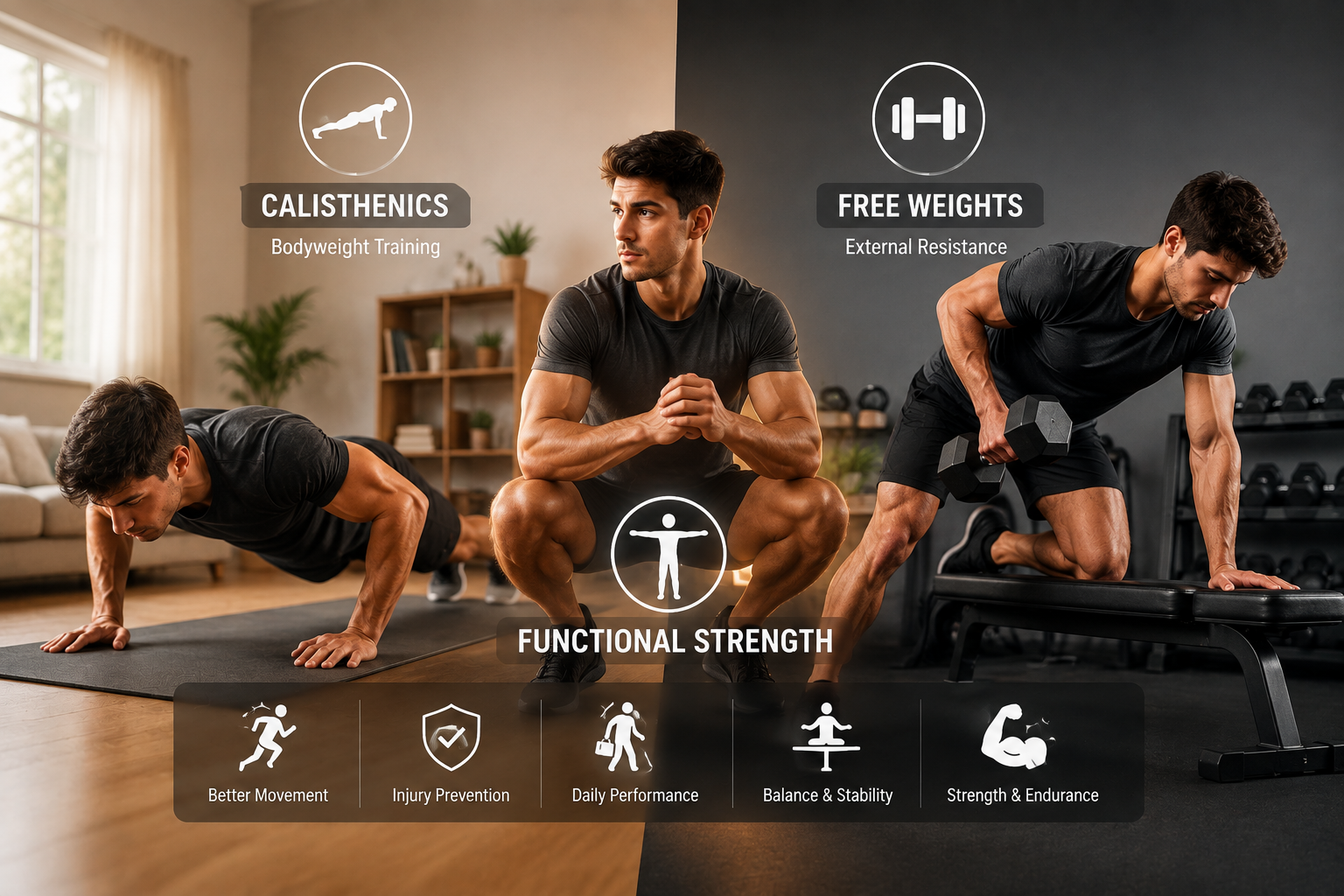
Building strength does not necessarily require a crowded gym, expensive machines, or a complicated workout routine. With the right approach, your home can become an effective training environment using nothing more than your body weight or a pair of dumbbells. This is where the debate between calisthenics vs. free weights becomes interesting. Both approaches can improve strength, muscle control, stability, and physical performance, but they challenge the body in different ways. Calisthenics uses body weight as resistance through movements such as push-ups, squats, lunges, planks, and pull-ups, while free weights use equipment such as dumbbells, kettlebells, and barbells to provide adjustable resistance. Current guidance from the American College of Sports Medicine emphasizes that both traditional weights and home-based bodyweight training can effectively improve strength and physical function.
Understanding Functional Strength
Functional strength is more than simply being able to lift a heavy object. It refers to your ability to produce and control force while performing movements that resemble the demands of everyday life, sports, work, and other physical activities. Getting up from a chair, carrying groceries, climbing stairs, lifting a bag, maintaining balance, or moving your body efficiently all require different combinations of strength, coordination, stability, and control. Resistance training can improve muscle strength, endurance, power, and the communication between the brain and muscles, making it valuable for overall physical function.
The most important factor is not whether an exercise looks impressive but whether it challenges the muscles appropriately and progresses over time. A beginner may become stronger simply by performing bodyweight squats or push-ups consistently, while someone with more experience may need additional resistance to continue making progress. The 2026 ACSM resistance-training guidance highlights that consistency and progressive training matter more than having complicated equipment or advanced techniques.
Calisthenics for Functional Strength at Home
Calisthenics is particularly convenient because your body provides the resistance. Exercises such as push-ups train the chest, shoulders, triceps, and core, while squats and lunges challenge the legs and hips. Planks and other controlled core movements help develop the ability to stabilize the trunk while the limbs move. More advanced movements, including pull-ups, dips, pistol squats, and handstand variations, can demand considerable strength and body control.
One of the biggest advantages of calisthenics at home is accessibility. You can begin with simple movements and gradually make them harder by changing leverage, range of motion, tempo, stability, or exercise variation. For example, a person who finds standard push-ups difficult can begin with an easier variation and gradually progress toward more challenging versions. This allows strength to develop without immediately purchasing equipment. ACSM’s latest guidance specifically notes that bodyweight exercises and home-based resistance training can produce meaningful improvements in strength, muscle development, and physical function.
Calisthenics can also encourage excellent body awareness because you have to control your own mass through space. However, it has a limitation: accurately increasing resistance can eventually become difficult. Once standard squats or push-ups become easy, adding another level of challenge may require advanced variations or additional equipment. Some movements can also place significant demands on joints and connective tissues when performed with poor technique, so progressing gradually and maintaining good form is important.
Free Weights for Building Strength at Home
Free weights offer a different advantage because resistance can be adjusted more precisely. A pair of dumbbells, for example, can be used for goblet squats, rows, presses, Romanian deadlifts, lunges, and many other movements. As your strength improves, you can gradually increase the load, making progressive overload easier to apply. This is especially useful for people whose main objective is developing greater strength or increasing muscle size.
Free weights also allow you to train muscles through a wide range of movement while requiring coordination and stabilization. Unlike fixed machines, dumbbells and barbells do not completely guide the movement, which means you need to control the equipment yourself. ACSM notes that free weights can improve strength, muscle size, power, endurance, and bone strength when used appropriately, although learning correct technique and following basic safety precautions is important.
The downside is that free weights require an initial investment and enough space to exercise safely. Heavy weights can also increase the consequences of poor technique or careless training. Beginners should learn movement patterns before attempting heavy loads, and exercises involving very heavy resistance may require additional supervision or a spotter. The objective should be controlled, progressive training rather than lifting as much weight as possible.

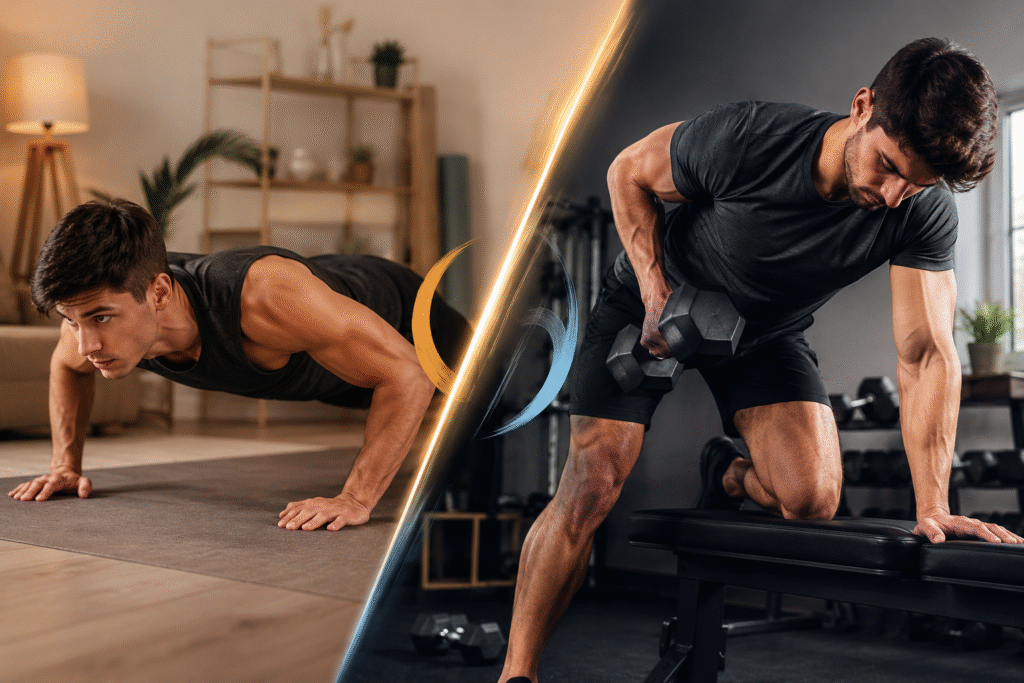
Calisthenics vs. Free Weights: Which Is Better?
There is no universal winner in the calisthenics vs. free weights debate because the better option depends on your goals, experience, available space, and preferences. If you want an inexpensive and convenient way to begin exercising at home, calisthenics is an excellent starting point. It develops body control and can provide a challenging full-body workout without requiring much equipment.
Free weights may be more suitable if you want precise control over resistance and a straightforward way to continue increasing the challenge. They can be particularly useful when your goal includes substantial strength or muscle development. Interestingly, current ACSM evidence does not suggest that one particular equipment type is automatically superior for the average healthy adult. Instead, the organization emphasizes matching training to your goal and choosing a routine you can consistently follow.
Why Combining Both Can Be the Smartest Approach
For many people training at home, combining calisthenics and free weights provides the best of both worlds. Bodyweight movements can develop coordination, balance, mobility, and body control, while dumbbells or other free weights can provide adjustable resistance for progressive strength development. A home routine might therefore include bodyweight push-ups and lunges alongside weighted rows, presses, squats, or deadlift variations.
Regardless of the equipment you choose, consistency is essential. General U.S. physical-activity guidance recommends that adults perform muscle-strengthening activities involving the major muscle groups on at least two days per week, alongside regular aerobic activity. Training should gradually become more challenging rather than suddenly increasing intensity or volume.
Supporting Your Workout With Healthy Lifestyle Habits
Exercise is only one part of building a stronger and more functional body. Adequate sleep, nutritious food, sufficient protein, hydration, and recovery all influence how well you can train and adapt. A balanced diet containing a variety of whole foods should remain the foundation of your routine rather than relying on a single food or beverage for fitness results.
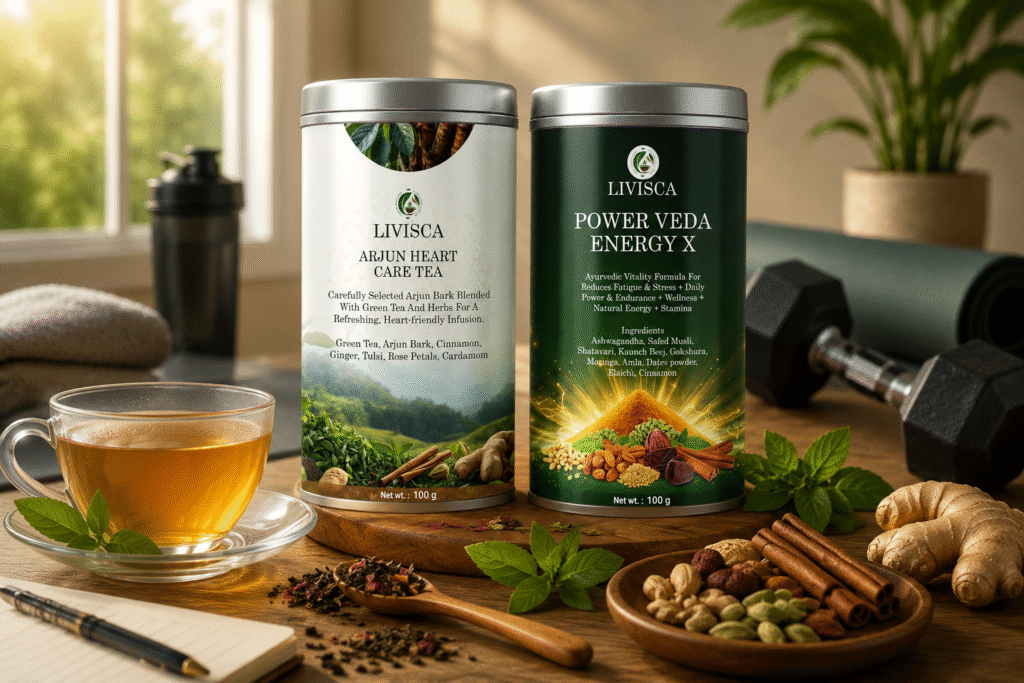
For people who enjoy tea, Livisca Green Tea can be a simple addition to a balanced daily lifestyle. Green tea naturally contains caffeine and can be enjoyed as a refreshing beverage, but it should not be considered a replacement for water or a substitute for proper nutrition and recovery. Research has found that green tea can still contribute to fluid replacement during mild exercise-related dehydration, although individual tolerance to caffeine varies.
Choosing the Right Home Strength Routine
The best home workout is ultimately the one you can perform safely, consistently, and progressively. Someone starting from zero may gain excellent results from basic calisthenics, while an experienced exerciser may benefit from adding free weights to create greater resistance. You do not need an elaborate setup to become stronger; you need a sensible training plan that challenges your muscles and allows them enough time to recover.
Whether you choose calisthenics, free weights, or a combination of both, functional strength develops through repeated practice, gradual progression, and good movement quality. Instead of focusing exclusively on which equipment is superior, focus on whether your routine is challenging enough, whether your technique is controlled, and whether you can maintain it over the long term. For most people training at home, the winning approach is not the one with the fanciest equipment—it is the one that turns regular movement into a sustainable habit and steadily makes everyday physical tasks easier.


Very informative
Nice